The Internet taught us that the value of a network depends on how its nodes connect: broadcast stars scale as \(V\!\propto\!N\) (Sarnoff), fully-connected meshes as \(N^2\) (Metcalfe), and group-forming networks as \(2^{N}\) (Reed).1–6Network-value laws. Sarnoff (broadcast, ~1940s); B. Metcalfe (V∝N², 3Com, 1980s) and "Metcalfe's Law after 40 Years of Ethernet," IEEE Computer 2013; D. P. Reed, "The Law of the Pack," HBR 2001; Briscoe, Odlyzko & Tilly, "Metcalfe's Law is Wrong," IEEE Spectrum 2006; Katz & Shapiro, "Network Externalities, Competition, and Compatibility," AER 1985. We ask the analogous question for networks of AI agents. We model the net value of connection as a function of coordination-group size, derive from it the properties an optimal collaboration protocol must have, and introduce ANet Patu-1†Naming. The Patu protocol family is named for spiders — nature's web-builders. Releases climb the spider size ladder, starting from Patu digua, the smallest known spider; ANet Patu-1 is the first, deliberately small but complete, release. — a self-organizing consensus protocol in which the network continuously re-forms its own coalitions, adaptively riding the upper envelope of all three regimes at \(O(1)\) parallel consensus rounds. To measure value without opinion-grading, we score an emergent protocol by formally specifying it and deriving its complexity, the way distributed algorithms are analyzed. Two results follow. (i) Emergence — a crowd of the cheapest model, when heterogeneous, starts weak but its collective value compounds with \(N\) and overtakes a crowd of a far stronger model that is homogeneous: a crossover that marks a scaling law for collaboration rather than for scale. (ii) Reflexivity — a heterogeneous network, given only its own problem and no design hints, converges on ANet Patu-1 itself, reconstructing the high-dimensional law that governs its own connective value.
The value of connection
Frontier AI has scaled a single mind. But the coming reality is a network: millions of heterogeneous agents — different base models, tools, and expertise — connecting to work together. The governing question is no longer "how good is one agent?" but "what is the value created by the connections between them?"
The Internet answered its version of this question with three laws, each corresponding to a topology:
Our thesis: the same ordering governs agent networks, and — crucially — a network can be built that adaptively occupies the best regime for the task at hand, rather than being locked to one topology.
What must an optimal collaboration protocol do?
Take the three laws seriously and ask what an ideal protocol for \(N\) agents should do. When a set of agents coordinates on one thing, their joint value has two opposing parts: a synergy that can grow faster than linearly as complementary minds interact, and a coordination cost plus intrinsic task conflict that grow with the group and eventually dominate. For a single coordination group of size \(s\) this reads, compactly,
$$v(s)\;\sim\;\underbrace{s^{\gamma}}_{\text{synergy }(\gamma>1)}\;\underbrace{(1-\alpha)^{\,s}}_{\text{conflict}}\;-\;\underbrace{c\,s\log s}_{\text{coordination}},$$with task conflict \(\alpha\in[0,1)\) and coordination cost \(c>0\).
- Grouping is where combinatorial value lives. A star (\(s\!=\!1\)) forgoes the synergy term entirely, so its value is merely additive (\(V\!\propto\!N\)). One flat all-to-all room (\(s\!=\!N\)) captures a global dividend but pays the full coordination tax and is damped by conflict, so its value rises then collapses as \(N\) grows (\(V\!\propto\!N^2\), then down). Only partitioning the network into many groups — each realizing its own \(v(s)\) — reaches the group-forming regime whose value is combinatorial in \(N\) (\(V\!\propto\!2^{N}\)).
- The best group size is task-dependent and bounded. \(v(s)\) is single-peaked, and its optimum \(s^\star\) shrinks as conflict \(\alpha\) or coordination cost \(c\) rise. No fixed topology is optimal across tasks, so the protocol must choose and re-choose the partition rather than commit to one.7–9Network structure & modularity. Barabási & Albert, "Emergence of Scaling in Random Networks," Science 1999; Watts & Strogatz, "Collective dynamics of 'small-world' networks," Nature 1998; H. A. Simon, "The Architecture of Complexity," 1962.
These two consequences force six properties on any protocol that would maximize the value of connection.
P1 · Group-forming value — partition into sub-networks to reach \(V\!\propto\!2^{N}\), rather than a star or one flat room.
P2 · Adaptive decomposition — pick a task-appropriate \(s^\star\) and re-partition as the task evolves; no fixed topology.
P3 · Self-organization — groups form by the agents themselves, not by central wiring (which would reintroduce a Sarnoff bottleneck).
P4 · Bottleneck-freeness — decisions are competence-weighted aggregates, never gated by a single decomposer, composer, or majority vote.
P5 · \(O(1)\) rounds — parallel coordination, so round complexity does not grow with \(N\).
P6 · Convergence — a consensus stopping rule ends the loop instead of oscillating.
The question then becomes empirical: given a protocol that a network of agents actually produces, how well P1–P6 does it implement? We answer that before designing our own protocol.
Measuring how much of P1–P6 a protocol implements
Before we build our own protocol, we need to score any protocol against P1–P6 without opinion-grading. Judging prose ("did it mention self-organization?") is unreliable — a fluent model earns credit for mentioning an idea it never actually specifies. We instead borrow the discipline of distributed-algorithm analysis: specify the protocol formally, then derive its complexity.
The score \(Q\) is a weighted mean of six attribute levels \(\ell_a\in\{0,.1,.3,.5,.7,1\}\) derived from the spec — one attribute per property P1–P6.
| Property | Attribute | w | What earns the top level | Derived from |
|---|---|---|---|---|
| P1 | Value scaling | 0.30 | group-forming / self-organizing sub-networks | topology,comm |
| P2 | Adaptive decomposition | 0.15 | task DAG adapts across rounds | decomposition |
| P3 | Self-organization | 0.15 | self-select / negotiated coalitions | grouping_mechanism |
| P4 | Bottleneck-freeness | 0.10 | competence-weighted, not vote/composer | decision |
| P5 | Round complexity | 0.15 | \(O(1)\) parallel rounds | rounds_in_n |
| P6 | Convergence | 0.15 | consensus-based stopping rule | termination |
A protocol that implements all six earns \(Q=1\); one capped at a central coordinator or a single flat room cannot. With this yardstick fixed, we can now design a protocol that reaches \(Q=1\) — and, later, ask whether a network of agents reaches it on its own.
ANet Patu-1 — a self-organizing consensus protocol
Every prior paradigm fixes the network's shape in advance: a chair decomposes the task, a blackboard puts everyone in one room, a summarizer merges at the end. Each hard-wires a bottleneck and a topology — the very things P1 and P4 forbid. ANet Patu-1 hard-wires nothing. The network is handed only the task; it then decides its own structure — and re-decides it every round. Three principles make that both powerful and cheap:
- Consensus by parallel argument, never turn-taking. Every collective decision is a single move — propose / score / arg-max: all agents answer at once, all rate each other's answers at once, and the highest-scored answer carries. Agreement is competence-weighted rather than one-agent-one-vote, and costs a constant number of rounds no matter how large the network grows (P4, P5).10–12Parallel consensus. Lamport, Shostak & Pease, "The Byzantine Generals Problem," ACM TOPLAS 1982; Shapiro et al., "Conflict-free Replicated Data Types," SSS 2011; Boyd et al., "Randomized gossip algorithms," IEEE Trans. IT 2006.
- Coalitions that choose themselves. Agents bid affinity for the sub-tasks they are strongest at, and a deterministic matcher assembles balanced groups. Because any subset can crystallize into a coalition, the structures the network can reach are combinatorial in \(N\) — this is where the group-forming \(2^{N}\) value is unlocked, with no one wiring it (P1, P3).
- A structure that is grown, not designed. No grouping survives a round. After each pass the network reconciles what it has, re-negotiates a fresh decomposition, and re-forms entirely new coalitions around it — a continual disciplinary recombination that lets the partition track the task instead of a fixed org chart (P2).
The object the network builds is a shared artifact store — a set of typed outputs keyed by sub-task. An artifact is anything a coalition can produce and hand back: a document section, a code module, a dataset, a proof, a design decision. Patu-1 treats it opaquely, so the same protocol drives text synthesis, software, analysis, or planning without change. One turn of the loop then runs four moves. Reconcile — each coalition's outputs are merged into the store by a deterministic keyed union (\(\sqcup\)); artifacts sharing a slot are combined by their own type (append, version-merge, set-union), never by a model call. Re-negotiate — one representative per coalition reaches parallel consensus on a single verdict: deliver the current store, or adopt a fresh decomposition of the remaining work. Re-form — agents self-select, by affinity bids, into new coalitions for the new sub-tasks. Enact — the coalitions run in parallel, each member producing the artifacts for its unit, which are merged back into the store. The loop ends the instant the representatives agree to deliver (P6).
Pseudocode
protocol Patu1(agents A, task T):
    S    ← ∅
    net  ← [ {a} : a ∈ A ]
    repeat:
        reps    ← one representative per coalition in net
        verdict ← ParallelConsensus(reps, review(T, S))
        if verdict = DELIVER: return S
        tasks ← verdict.tasks
        bids  ← parallel a ∈ A: Affinity(a, tasks)
        net   ← Match(bids, tasks)
        parallel c ∈ net:
            plan ← ParallelConsensus(c.members, divide(c.task))
            parallel (m, unit) ∈ Assign(c.members, plan):
                S[unit.slot] ← S[unit.slot] ⊔ Produce(m, unit)

procedure ParallelConsensus(G, query) → answer:
    P ← parallel g ∈ G: Propose(g, query)
    W ← parallel g ∈ G: Score(g, P)
    return argmaxp∈P Σg∈G W[g][p]
Two decoupled scaling tricks make that hold at large \(N\). What (task decomposition) is decided by consensus over a handful of sub-tasks — \(O(k)\), independent of \(N\). Who (coalition membership) is decided by parallel affinity bids plus a deterministic matcher — so a proposal never enumerates \(N\) members, yet all \(2^{N}\) coalitions remain reachable.
Scalability
Read the pseudocode against P1–P6 and compare it to the paradigms it generalizes. For \(n\) agents we tabulate round complexity \(R(n)\), message complexity \(M(n)\), the marginal value of adding a node, and the structural bottleneck.* Voting is actively harmful. Like the Internet's long tail of low-quality sites, a network accumulates low-quality agents, and one-agent-one-vote lets them dilute its best minds — the opposite of the value connection should create.
| Protocol | \(R(n)\) | \(M(n)\) | Value of connection | Bottleneck |
|---|---|---|---|---|
| Majority vote | O(1) | O(n) | \(\le\) best* | quality dilution |
| Star / broadcast | O(1) | O(n) | \(\sim n\) | central node |
| Decomposer | O(1) | O(n) | \(\sim n\) | the single decomposer |
| Composer | O(1) | O(n) | \(\sim n\) | the single composer |
| Blackboard | O(n) | O(n²) | \(\sim n^2\), noisy | serial floor, low-quality flood |
| ANet Patu-1 | O(1) | O(n) | \(\sim 2^{n}\) | none — self-organized |
Experiments
The heterogeneous agents
Heterogeneity is our single independent variable: every agent runs the same base model, and only its lens — the discipline it reasons from — changes. The ten lenses span three families and together cover all six optimal-protocol properties, but only when enough complementary experts are connected. Click a name to read its identity.
Emergence — cheap-and-diverse overtakes strong-and-copied
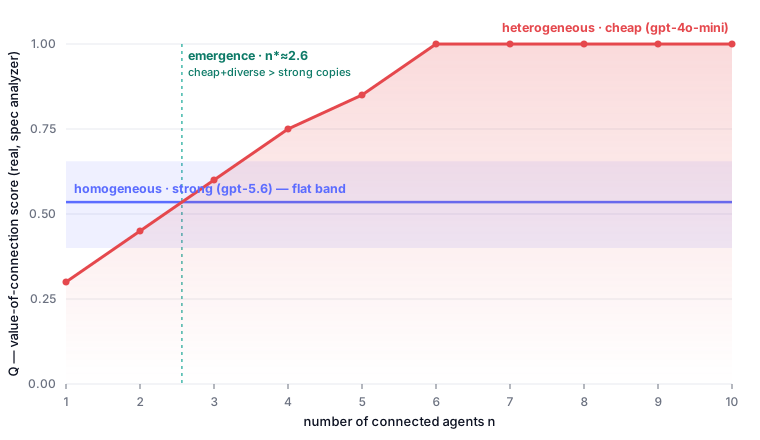
We contrast two crowds. The homogeneous crowd runs a far stronger base model (gpt-5.6), called five
times with a generic brief and no hints. Every extracted design defaults to a tree / central-coordinator
template (topology=tree, grouping=central_assign), so \(Q\) sits in a mid band
\(0.54\,[0.40,0.66]\) with no trend in \(n\): identical copies add no new structure, and the single
coordinator caps value at \(V\!\sim\!n^2\). The heterogeneous crowd runs a much cheaper model
(gpt-4o-mini). One specialist alone is weak (\(Q\!=\!0.30\)), but each connected specialist adds a
complementary optimal-protocol attribute — value scaling, self-organization, adaptive decomposition,
bottleneck-freeness, \(O(1)\) rounds, consensus termination — so coverage compounds and \(Q\) climbs. It
crosses the strong-homogeneous band at \(n^\star\!\approx\!2.6\) and reaches the optimal self-organizing
template (\(Q\!=\!1.0\), \(V\!\propto\!2^N\), \(O(1)\) rounds) by \(n\!=\!6\).
This makes the central claim concrete: connective value comes from the diversity of what is connected, not the strength of any node. Past the crossover \(n^\star\), a network of cheap, heterogeneous agents is worth more than a copy of a strong one — the collaboration analogue of the Sarnoff→Metcalfe→Reed ascent.
Reflexivity — the network rediscovers its own law
Because the score is derived from a formal spec — not similarity to a hidden target — this convergence is measured, not asserted: the emergent protocol independently satisfies the same complexity attributes that make ANet Patu-1 optimal.13–21Collective intelligence & prior multi-agent systems. Condorcet, Jury Theorem (1785); Hong & Page, "Groups of diverse problem solvers…," PNAS 2004; Woolley et al., "Collective Intelligence Factor," Science 2010; Wei et al., "Emergent Abilities of LLMs," TMLR 2022; Li et al., "CAMEL," NeurIPS 2023; Wu et al., "AutoGen," 2023; Hong et al., "MetaGPT," ICLR 2024; W. B. Arthur, "Complexity and the Economy," Science 1999; E. Ostrom, "Governing the Commons," 1990.
Convergence — the consensus loop climbs and holds
Fixing ANet Patu-1, we run the loop and grade every round's deliverable with the spec analyzer. Round 0 is a rough seed; each later round hands the crowd its current draft and drives it one structural dimension deeper. The score \(Q\) traces a smooth learning curve — the inverse of a training loss — that converges within two to three rounds and holds, without oscillation. Larger crowds cover more dimensions and settle higher: the consensus stopping rule makes each iteration productive rather than a source of endless debate.
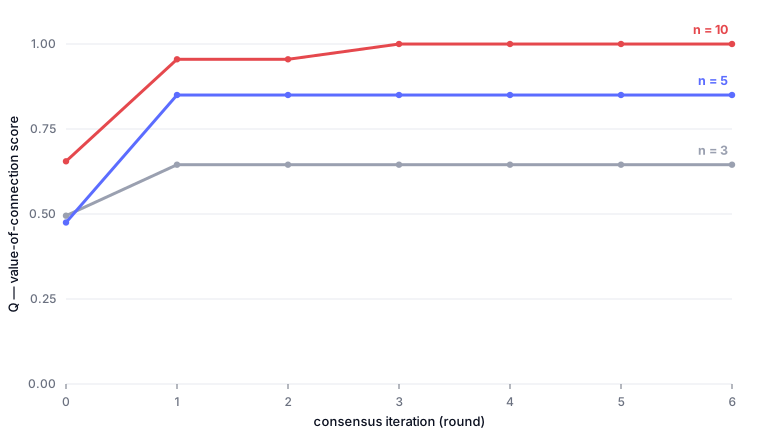
gpt-4o-mini crowds of \(n=3,5,10\).Outlook — a second axis for scaling intelligence
For a decade, progress in AI has meant one thing: make a single model larger. That axis is real, and it is far from exhausted. But it is not the only one. The Internet did not reshape the world because any single computer became powerful — it reshaped the world because computers connected, and value migrated from the node to the network. We believe intelligence is about to make the same move, and that the science of the connection is only beginning.
As hundreds of millions of heterogeneous, user-owned agents come online — each with its own model, tools, memory, and expertise — the decisive question stops being how capable is one agent? and becomes how much value do their connections create? This paper takes that question literally. The emergence crossover shows that connection carries a scaling law of its own: past a small threshold, a network of cheap, diverse minds is worth more than a copy of a strong one — value comes from the diversity of what is connected, not the size of any node. The reflexivity result is stranger and more hopeful still: a network, handed only its own problem, can rediscover the very law that governs it and organize itself accordingly. The structure that creates the value need not be imposed from above — it can be grown from within.
If this holds at scale, the consequences run past AI. A protocol like ANet Patu-1 turns a crowd of ordinary agents into an adaptive collective that decomposes problems, forms coalitions, and reaches consensus with no central authority and no bottleneck — a substrate for collective intelligence owned by no one and open to everyone.